
Why Fabric Choice Decides Whether a Bra Succeeds
Lingerie fabric selection is often treated as an aesthetic decision, made from a swatch book after the design is fixed. In practice, it is one of the earliest and most consequential technical decisions in a bra program. The fabric determines how the bra feels, how it stretches and recovers, how it washes, how it holds color and, ultimately, whether the product delivers the function the customer was promised.
For buyers and private label brands, the challenge is that many linge fabrics look similar in a swatch but behave very differently in a finished garment. A fabric that feels luxurious may recover poorly; one that performs well may dye inconsistently. This guide explains the main lingerie fabric families, how to match material to function, and what to verify before committing to bulk.
The Main Fabric Families in Lingerie
Nylon-spandex
The workhorse of lingerie. Nylon gives strength and a soft hand, while spandex provides stretch and recovery. It is used across smooth, seamless, molded and sewn bras. Its advantages are excellent recovery, a smooth surface and good dyeability. Its main drawback is cost relative to polyester.
Polyester-spandex
Durable, cost-effective and excellent at holding color and print. It is common in fashion-driven ranges and printed styles. It feels slightly less soft than nylon and is generally less breathable, which makes it less suited to comfort-focused seamless products.
Viscose and modal blends
Viscose and modal offer a cool, silky hand feel and are widely used in soft support and seamless comfort bras. They bond well, which makes them suitable for bonded construction. They require more careful handling because they can be less dimensionally stable than synthetic options.
Cotton blends
Valued for breathability and a natural feel, particularly in markets where cotton is a strong purchase driver. Cotton blends usually include spandex for stretch. They are less common in high-smoothness applications because cotton surfaces are not as uniform as synthetics.
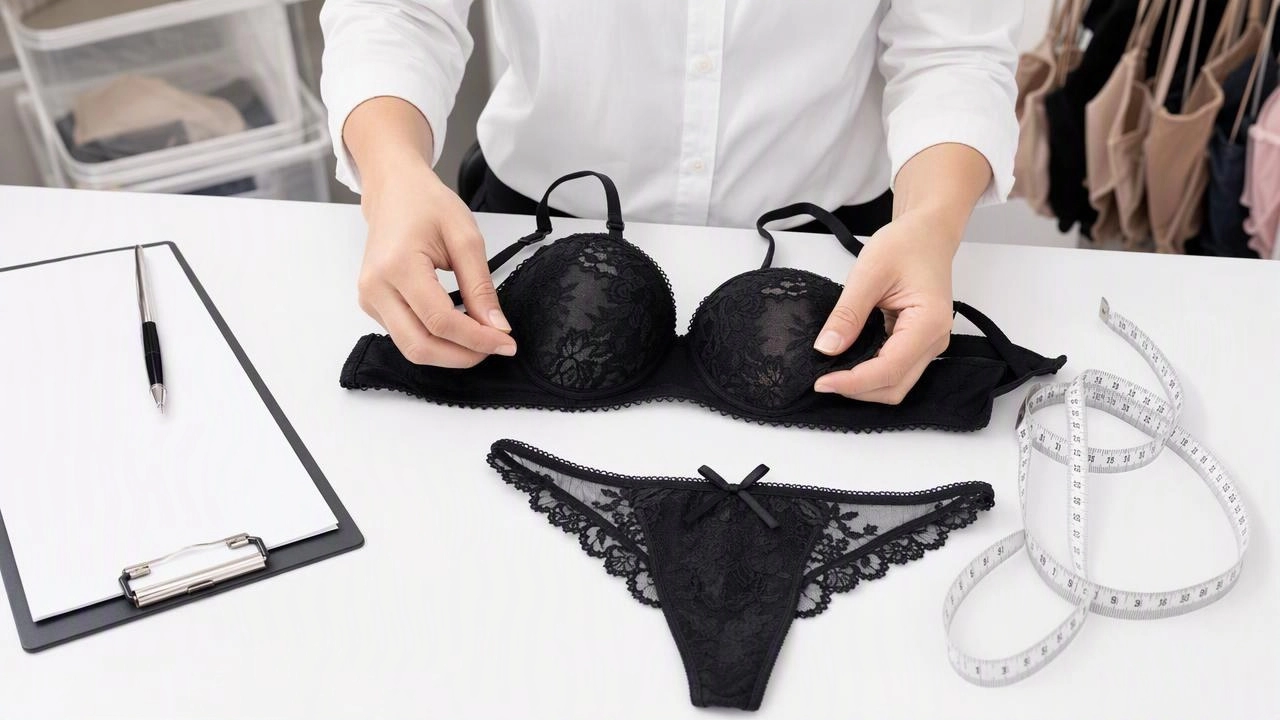
Lace and tulle
Used as decorative or structural overlays. Lace may be rigid or stretch, and the choice affects how the cup edge behaves. Tulle and power mesh are used for support and coverage without bulk.
Spacer and foam
Three-dimensional knits and foams provide cup shape and breathability. Spacer fabric is popular for molded and seamless programs where a light, breathable cup is required.
Matching Material to Function
The most reliable way to select fabric is to start from the product's function rather than its appearance.
Everyday comfort and invisibility
Prioritize smoothness, breathability and recovery. Fine-gauge nylon-spandex, viscose blends and spacer fabric are common choices. The fabric must sit flat under clothing and retain its shape through repeated washing.
Support and shaping
Prioritize recovery, firmness and stability. Firmer materials, laminated constructions and power mesh support the shaping requirement. A soft fabric will not deliver support no matter how well the pattern is designed.
Fashion and decoration
Prioritize drape, color brilliance and how the material takes lace, print or embroidery. Polyester-spandex and fine laces perform well here, and decoration can carry the design.
Fuller bust and plus size
Prioritize tensile strength, recovery under load and dimensional stability. Materials that perform at a medium cup may sag at a larger cup, so the specification must be verified at the sizes the program will actually serve.
Sensitive skin and long wear
Prioritize a soft hand, breathability and smooth edges. Hardware should be nickel-free where market regulations require it, and any bonding adhesive must be skin-safe.
Fabric Properties Buyers Should Specify
Rather than describing fabric in adjectives, buyers should request measurable properties.
- Composition: the exact fiber percentages, which also determines care labeling.
- Weight and thickness: affects hand feel, opacity and coverage.
- Stretch percentage: how far the fabric extends in each direction.
- Recovery: how completely it returns to its original dimensions.
- Dimensional stability: shrinkage or growth after washing.
- Color fastness: resistance to fading and to bleeding onto other materials.
- Hand feel: softness, smoothness and drape, agreed through physical swatches.
- Bondability: where bonded construction is used, how well the fabric fuses.
How Fabric Choice Affects the Whole Program
Fit and grading
A fabric with different stretch than expected changes how the pattern performs. A late fabric change can invalidate a completed fit approval.
Construction method
Not every fabric can be bonded, molded or laser-cut. Choosing a fabric that suits the intended construction avoids late-stage redesign.
Cost
Material is typically the largest single cost in a bra, so fabric choice has a larger effect on unit cost than most other decisions.
Minimum quantity
Custom-dyed or specialty fabrics carry minimums that can set the real order floor, so fabric choice and MOQ planning are linked.
Care and longevity
The care label and the product's usable life both follow from the material. Choosing a delicate fabric while promising easy care creates a mismatch that leads to returns.
Verifying Fabric Before Bulk Production
- Approve a physical swatch for hand feel, color and appearance.
- Confirm tested stretch and recovery values, not just a visual check.
- Run a wash test to verify dimensional stability and color fastness.
- Test compatibility if the fabric will be bonded or molded.
- Confirm availability and minimums for the intended production quantity.
- Check color consistency between fabric, lace, elastic and trims.
Common Fabric Mistakes
- Selecting fabric from a swatch without testing recovery.
- Changing fabric after fit approval.
- Assuming a fabric that feels good will support well.
- Ignoring color matching between fabric, lace and trims.
- Overlooking fabric minimums when planning order quantity.
- Choosing a delicate fabric while promising easy-care performance.
Frequently Asked Questions
What is the best fabric for a seamless bra?
Nylon-spandex and viscose blends are common choices because they combine a smooth surface, good recovery and, in the case of viscose, strong bonding compatibility. The best choice depends on whether the priority is smoothness, breathability or support.
Is polyester or nylon better for lingerie?
Nylon generally offers a softer hand and better recovery, while polyester is more economical and holds color and print well. The right answer depends on the product's function and price position.
Why does fabric matter for MOQ?
Because many fabrics carry minimums per color and per material. Custom-dyed or specialty fabrics can set the actual order floor, so fabric selection and order planning must be considered together.
How do I check color consistency across materials?
Approve every component against a single color standard and check them together under consistent lighting. This is especially important when fabric, lace, elastic and trims come from different suppliers.
Can I use the same fabric across multiple styles?
Often yes, and doing so can improve efficiency and reduce minimum quantity pressure. However, each style must still be fit-tested with that fabric, since the same material behaves differently in different constructions.
Lace Selection: Rigid Versus Stretch
Lace deserves its own discussion because it is the most decorative material in most lingerie programs and the most likely to cause fit surprises.
Rigid lace
Rigid lace holds a defined shape and is often used over a structured cup. It gives a crisp, graphic appearance and provides some support of its own. Its limitation is that it does not follow the body, so the pattern must accommodate its lack of stretch.
Stretch lace
Stretch lace follows the body and is common in soft support and seamless styles. It is comfortable, but its elasticity means the cup edge can become wavy if the pattern is not developed carefully.
How to choose
- Match the lace to the cup construction: rigid lace over a structured cup, stretch lace for soft cups.
- Check the lace edge: a scalloped edge may or may not suit the intended neckline.
- Confirm the lace width suits the panel it will cover.
- Verify the lace color against the base fabric, since lace and fabric rarely dye identically.
- Test the lace on the sample for comfort, since some laces have a scratchy edge that is not apparent in a swatch.
Fabric Testing Before Bulk Approval
Material approval should be based on tests rather than impressions. The following protocol covers the essentials.
- Swatch approval: physical approval of hand feel, appearance and color.
- Stretch test: measured extension in both directions.
- Recovery test: measured return to original dimensions after extension.
- Wash test: dimensional stability, color fastness and surface change after repeated laundering.
- Bonding compatibility: where bonded construction is used, verification that the bond holds after washing.
- Color matching: all components checked together against a single standard.
Buyers who insist on these tests before bulk approval avoid the most common causes of post-delivery complaints, which are almost always material-related rather than pattern-related.
Choosing Fabric with Purpose
Fabric selection is where a lingerie program's function is either supported or undermined. Buyers who define the product's purpose first, then specify measurable fabric properties, consistently avoid the expensive late changes that follow from aesthetic-only decisions.
The most efficient approach is to select fabric early, test it thoroughly, and then lock it before pattern work advances. This sequence keeps fit work valid, keeps construction decisions aligned with material behavior, and produces a product whose comfort and durability claims are grounded in the actual materials used.
Plan Your Next Lingerie Collection
Share your product brief with our development team.